BROWSE JOURNEYS BY MAP VIEW

Showing posts with label sentinel works. Show all posts

Saturday, 20 September 2025

Glasgow Engine Works


Travels by train around Glasgow visiting former engine works sites.

Alley and MacLellan - Sentinel Works

Most famous as makers of the Sentinel Steam Waggon, production of which moved to a purpose built works in Shrewsbury from 1915. (I previously visited the former Shrewsbury works, more details here) The Glasgow works went on to produce all manner of industrial machinery. More details about Alley and MacLellan and their products can be found on the Graces Guide website.

Below - One of the Glasgow built Sentinel Steam Waggons in Glasgow's Riverside Museum.


These days the works is in quite dilapidated condition but part of the site is used for a car boot sale every Wednesday, Saturday and Sunday so I visited on a Wednesday so that I could look around the site.

The site is a 0.8 mile walk from the nearest station at Crosshill which is a short ride from Glasgow Central.


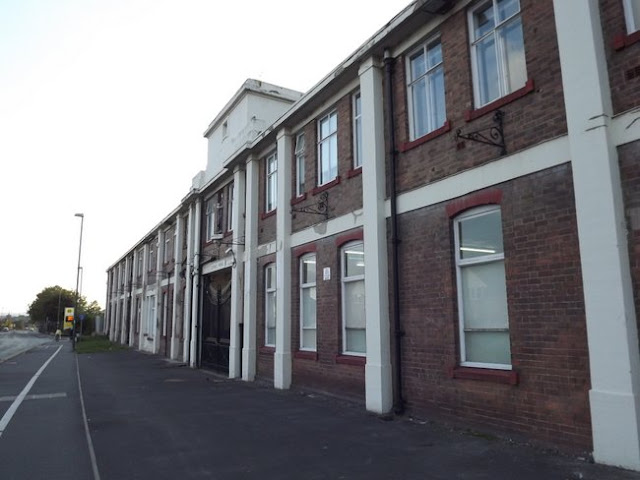
Below - The former works offices, sadly derelict and not accessible. The building looks very 1930s but was actually built around 1904, a forerunner of the style and construction techniques of buildings that would become commonplace decades later.


Below - Entrance to the works off Jessie Street.


Below - Weighbridge still in situ at the former gateway to the works yard.


Below - Rear of the office building.


Below - Where the works backs on to what was Polmadie Mineral Depot and is now Alstom's Polmadie train depot there is evidence of the rail connection to the works.


Below - These rails were probably used by a crane in the works yard.


Below - Inside the former works building.


Dubs & Co / North British - Queens Park Locomotive Works

Just west of the former Sentinel works was the Queens Park Locomotive Works of Dubs & Co. In 1903 a merger between Dubs, Sharp Stewart and Neilson Reid formed the locomotive making giant North British that would make Glasgow the biggest maker of locomotives in the United Kingdom. North British would go on to be the largest engine maker in Europe and second only to American firm Baldwin in the world.

Industrial buildings still occupy the site of the works but after comparing maps these buildings do not seem to follow the footprint of the former engine works, I had wondered if they might have been old buildings that had been re-clad. Just the perimeter wall of the site survives of the old works, though at one point there are bricked up windows that would presumably have been part of the works offices. I didn't visit the site on this occasion, going next instead to Springburn and the former heart of the North British firm, their head offices.

Neilson Reid & Co / North British - Hyde Park Works


Above - North British 21753, SAR 1535 "Susan" in South Africa. Much of North British's production was for export.


Neilson Reid's Hyde Park works was situated on the north side of Flemington Street in Springburn, a short walk from Springburn station. The works was just across the railway line from Sharp Stewart's Atlas works so when the three firms merged it was decided to build the new administration building for North British opposite the Hyde Park works. The works itself has been demolished, Glasgow Kelvin College has been built on the site, but the administration building survives.

Below - The huge administration building from the North British Locomotive Company.


Below - The initials of the company and a locomotive above the doors.


Below - Blue plaque on the building.


Below - The NBLCo initials in the gates.


Below - The Glasgow Kelvin College buildings on the site of the Hyde Park Works. The bays of the old works are marked out in the paving.


Below - View of the admin building from the east across the site of the Craigpark Telegraph and Electric Cable Works.


Below - The building from Adamswell Street.


Sharp, Stewart & Co / North British - Atlas Works

The Atlas Industrial Estate occupies the former Atlas Works site across the railway from the former Hyde Park Works site, I didn't visit this site as there doesn't seem to be any trace of the former works looking at satellite images. 

Below - Sharp Stewart built many of the B Class engines still in use on the Darjeeling Himalayan Railway.


Caledonian Railway / LMS / British Rail Engineering Ltd - St Rollox Locomotive Works


A short walk south of the Hyde Park works was the St Rollow works of the Caledonian Railway. It passed through the various changes in railway ownership through the London Midland & Scottish Railway, British Railways and British Rail Engineering Ltd. After privatisation the works has been through a few private owners. The works has been downsized a few times with buildings on the north of the site demolished and redeveloped with a Tescos superstore. Buildings to the south of the site are in other industrial uses.

Below - The BREL gates still in situ on the former office building.


Below - Blue plaque on the former works office building.


Below - The former works office building on Springburn Road.


Below - Rear of the office building seen from the Tescos site.


Below - A column from the demolished part of the works retained in the Tescos site as it has the names of workers from the early 1900s engraved on it.


Below - Works buildings seen from Springburn Road.


 I went to the Tesco car park as at one time the railway sidings in to the works could be seen from the Tesco car park, however the rail access was quite overgrown. The previous owners of the works had closed it down and the site had had a recent change of ownership so the hope is there will be a revival of the works.

North British Railway / LMS / British Rail Engineering Ltd - Cowlairs Works

Also worth a mention in the same area but completely demolished is the Cowlairs Works of the North British Railway. It underwent the same series of railway ownership as St Rollox following the railway grouping of 1923. BREL closed the site in 1968 and concentrated work in the area on the St Rollox works. The Carlisle Street Business Park and Cowlairs Industrial Estate have been built on the former works site. The works can be seen on the above old map to the west of the Hyde Park works. I didn't visit the site since there is nothing to see of the old works and instead returned to Springburn station,

Saturday, 2 April 2022

Sentinel Works, Shrewsbury

Starting Point - Shrewsbury Station. Round trip to former Sentinel Works. Distance 2.8 Miles


Above - Sentinel locomotive 68153 on the Middleton Railway. Below - Super Sentinel steam lorry.


In the early 20th Century several firms around the country produce steam powered lorries. They turned out to have a fairly short lived popularity, in the aftermath of the first world war the market was flooded with petrol and diesel powered lorries that had been used in the war effort. The war also saw massive develop of internal combustion engined machines on both rail and road. Sentinel's route go back to the Glasgow works of Alley & MacLellan who started making steam lorries in Glasgow in 1905 before establishing the Sentinel Works in Shrewsbury in 1915. The original designs carried on in production in Glasgow until 1923 when Sentinel introduced their updated Super Sentinel. The Glasgow office buildings used an innovative pre-fabricated concrete design and this was also employed at the Shrewsbury works with parts of the works cast in kit form in Scotland.
Sentinel also ventured in to building steam shunting locomotives based on their steam lorry designs. Their vertical boilers were quicker to raise steam and more suitable for one man operation so were handy for smaller industrial railway systems and more occasional than regular use. 
Steam lorries had a bit of a resurgence around the second world war in the face of fuel shortages and the country's abundant coal supply but internal combustion had taken over shortly after the war. The company was taken over by Rolls Royce with the intention of producing diesel engines at Shrewsbury. Diesel locomotive production also took place but lorry production didn't. In the mid 1960s Sentinel developed their Steelman loco, earmarked to replace many steam engines still operating in the steel industry. In the end redundant British Railways class 14 locomotives that had seen little use proved to be a cheaper option and the orders dried up. Eventually locomotive production within the Rolls Royce group moved to Sentinel's former agents and maintenance specialist Thomas Hill of Rotherham who had also become part of Rolls Royce. Thomas Hill undertook several orders to convert Sentinel steam locos to diesel power, being ideally suited for conversion due to their chain drive arrangement. They also produced new locomotives under the Vanguard brand name, Thomas Hill also took on the goodwill and designs of the Yorkshire Engine Co at nearby Meadow Hall whose works I saw on a previous railway walk covered here.

Below- Sentinel diesel shunter on the Llanelli & Mynydd Mawr Railway.


The Sentinel works carried on producing parts for aerospace engines through the Rolls Royce family of companies and subsequent changes of ownership. Most of the works survives today with part of the site having been redeveloped as a Morrisons supermarket.
More about the history of Sentinel can be found on the Wikipedia article
The former works is a 1.4 mile walk from Shrewsbiry station, following the A5191 for most of the way. 


On the way one interesting sight is the Shrewsbury Flaxmill Maltings. The mill was built for Thomas and Benjemin Benyon, pioneers of flax spinning and partners with Leeds Flax miller John Marshall who's Scotland Mill (near Leeds despite the name) and whose complex in Holbeck I have previously visited. I have yet to write up the visit to Scotland Mill but have previously covered the Holbeck mills in this article for the leedsengine.info website
Fires in the earlier mills of the industrial revolution were a common problem with many of the materials handled being quite flammable. This building addressed this problem by being build of brick around a cast iron frame. It is considered to be the grandparent of modern skyscrapers, such a historic building that parts of the complex have been given Grade 1, 2* and 2 listing. It operated as a Flax mill from 1797 to 1897, on closure it stood empty for around 10 years before being converted to a maltings as which it continued in use until 1987. At the time of my visit it was under restoration and largely obscured by scaffolding and surrounded by hording. At the time of writing it is about to reopen as a tourist attraction and offices so I'll visit another time when I can get a better look. More information, including a detailed history of the complex can be found on the Shrewsbury Flaxmill Maltings website.


Continuing to the site of the Sentinel works we pass a Morrisons supermarket, this occupies part of the former works though thankfully much of the works including the earlier buildings and key buildings such as the offices survive.

Below- The former main entrance to the works (now replaced with a side entrance more suitable of the larger lorries around now. The Sentinel and his sword of the company logo still stand guard over the gateway. 


Steam lorries can occasionally be seen at the front of the former works as being possibly the most successful steam lorry make several survive in preservation and many owners will pose their restored examples in front of the works if they are in the area. Another location on the Sentinel grand tour is the Horseshoe Pass near Llangollen, a steeply graded route often used as a test track for the machines produced here.
It is interesting to note the position of the houses on the opposite side of the street built diagonally to the main road to provide a turning circle to allow lorries in and out of the gateway.

Below - The office building at the front of the Sentinel works.


Below - Heading north east along the A5112 some of the original works buildings can be seen.

Below - The northern edge of the complex. To the right of the image was once the end of a siding connected to the nearby railway to Crewe. The site of the end of the siding is now occupied by a women's gym. I didn't point my camera at the gym to take photos.


The old map also shows a small siding on the northern edge of the site, this looks to have been for the purpose of supplying coal to the factory's engines. This is now well within the surviving complex.

Below - The current side entrance to the complex with some more of the surviving works buildings.


Below - The southern edge of the complex has been demolished and redeveloped with the Morrisons supermarket and the road in to it. The office building forming the southern edge of the surviving complex.